Contact Me: abeattie73@gmail.com

Saturday, March 23, 2019


This week we read the book Grandfather Tang's Story, by Ann Tompert, continuing with our exploration of two dimensional shapes.  This is a Chinese folk tale about two fairy foxes told in tangrams, which are seven shapes cut from a square that are arranged to make other shapes.  In this story the foxes shift their shapes to become different animals.  After we read the story, children explored with plastic tangram pieces and then made their own pictures using tangrams cut out of paper.


Saturday, March 16, 2019


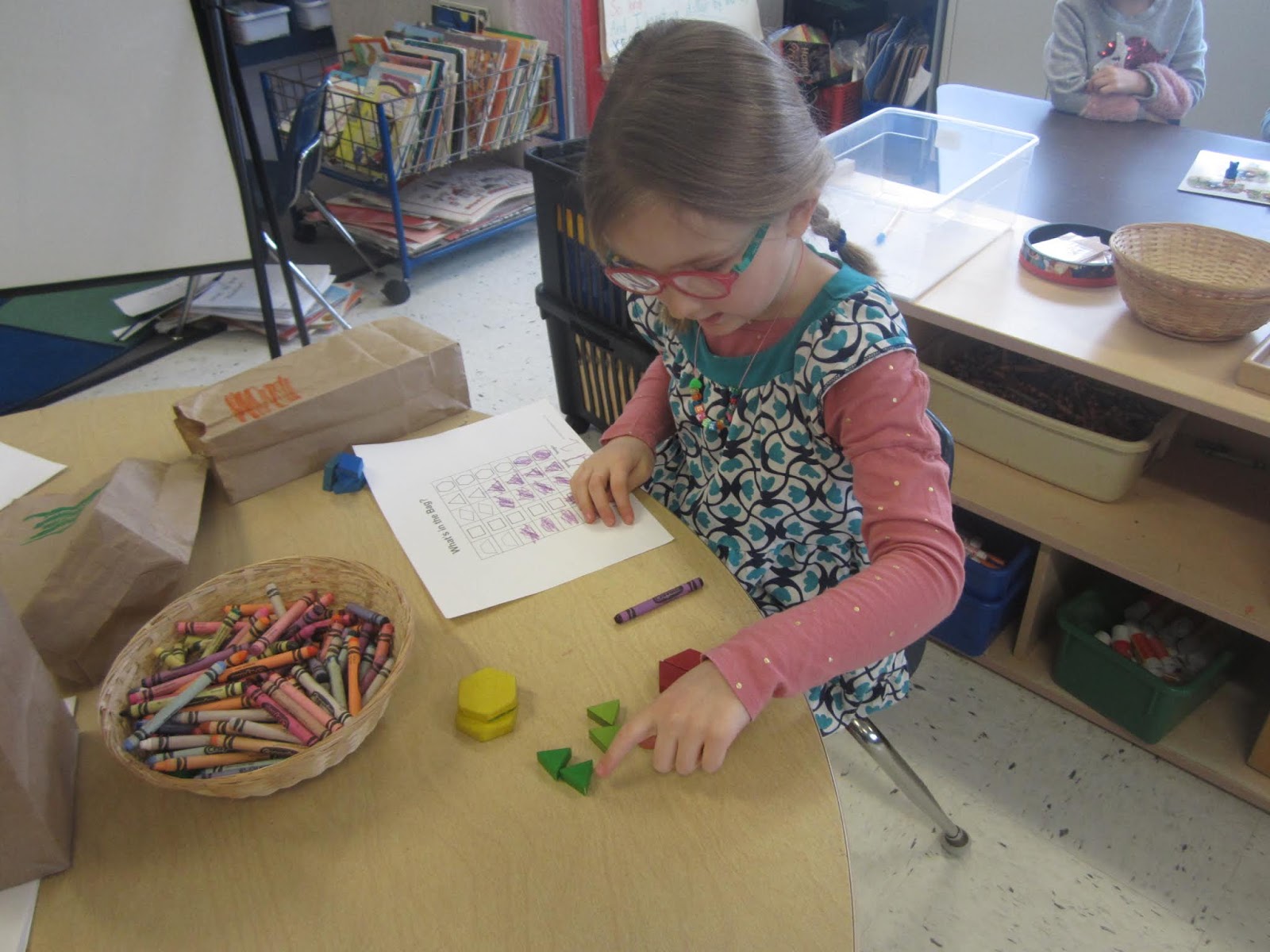
In math we have started a unit on geometry.  Our focus thus far has been observing and describing two-dimensional shapes, noting each shape's distinguishing features, such as number of sides and corners or vertices.  We have spent time sorting shapes by different attributes, recording different ways one set of shapes can be sorted.

Children also had an opportunity to explore different ways of composing a larger shape using smaller shapes (e.g. a hexagon can be made with two trapezoids or 1 trapezoid and 3 triangles).  They used pattern blocks to fill in an outline of an object.  Once they had covered the object with blocks they used pattern block stickers to make a permanent representation.  They finished by completing a simple table, recording how many of each shape they used as well as the total number of shapes.   It's interesting to compare the different ways children fill in the same outline.  Lots of rich math is hidden in this super fun and engaging activity.

In addition we played a game called the barrier game.  Partners each have a three by three grid, hidden from the view of the other partner.  One partner uses specific directions to tell the other partner where to place shapes on the grid, trying to create two matching grids.  This activity provided practice in naming shapes and using position words such as above and below.  It's also a great exercise in speaking clearly and listening!


Monday, March 11, 2019

Last week we started a Project Lead the Way science unit on forces and motion called "Pushes and Pulls."  In this unit, students will explore different forces and identify them as pushes or pulls.  We will also explore the effects of different strengths and directions of pushes and pulls on the motion of an object.  So far we have learned that pushes are forces that move an object away and pulls are forces that move the object closer.  While most often we can see the force being applied, we have also talked about forces that we might not see, including wind and gravity.

Over the last few days we have been noticing pushes and pulls that we use throughout our days.  It's amazing how many we were able to identify once we started paying attention!  Some of these include pushing or pulling a door to open it, pulling on snow pants, shoes, boots, mittens, pushing in a chair, pushing and pulling pencils and markers to write, pulling paper towels out of the dispenser, pushing and pulling the faucet to turn it on and off, pushing and pulling sleds, snowballs, swings and myriad other objects on the playground.  When we start thinking about it the list is endless.


Pushing in a chair

Pushing and pulling to cut

Using wind to push a propellor

Pushing the door open

Pulling a zipper

Pushing and pulling a crayon

Pushing a sled

Pushing and pulling the tire swing

Pushing a swing

Pushing a snowball... up the hill!

Pulling to climb up the structure

Friday, February 22, 2019

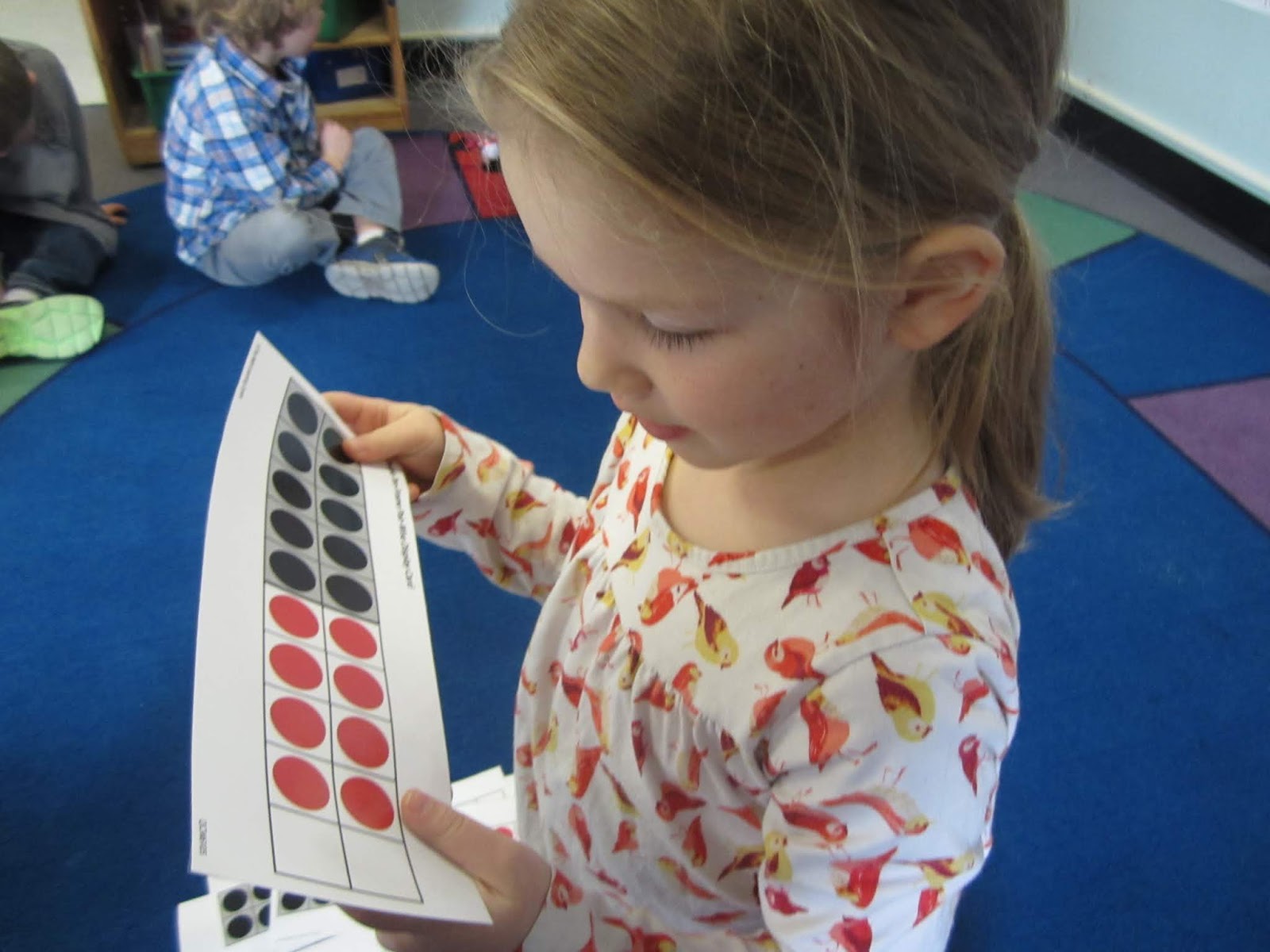
During February, Number Corner part of our focus has been on teen numbers.  Children have learned to think of teen numbers as 10 ones and some additional ones.  To reinforce this concept we have been playing a game called capture the teen number.  The class is split into two teams, orange and blue.  Team members take turns flipping a  teen card and covering the corresponding number on the number line with a sticky note that matches their team's color.  The cards we use are double ten frame cards, with the first 10 dots shown in black and the rest of the dots in red.  We have worked on strategies for quickly identifying the quantity without counting all of the dots.  Some examples are  touching the black dots and saying 10 and then counting on for the red dots (10...11, 12, 13) and looking for familiar number combinations such as doubles.  Many children are now able to immediately recognize how many red dots are showing and can name the teen number.  When children identify the number instantly I ask them to share how they know so quickly.  Some of their explanations include ideas like "I saw 3 dots on top and 2 on the bottom and I know 3 and 2 is 5," "I saw 4 dots like on a dice and one more and I know 5 is one more than 4," and "There are 2 empty spaces and I thought one empty space would mean 9, so 2 empty spaces is 8."

A different game had children working with partners to show teen numbers, with one person showing 10 and the other person showing more fingers to make the corresponding teen number.  Learning to compose and decompose teen numbers into 10 ones and some more ones lays the foundation for understanding place value and the base ten system.


Thursday, February 21, 2019

On Thursday we had a very special visitor in kindergarten:  Fred the therapy dog!


Fred is 4 years old and weighs 210 pounds.  He eats three times a day and loves other dogs and cats.  Children will have an opportunity to read to Fred when he visits our school on Thursdays.  Thanks to Katie Babic for making this happen.

Saturday, February 16, 2019

Finally, after rescheduling four times because of all kinds of weather, Carrie was able to come to school this week for an ECO session focused on animals in winter and tracking. We began the morning with an interactive story about different animal gaits and the track patterns created by each of these:  hoppers, walkers, bounders and waddlers.  Children then had an opportunity to try each gait, following tracks laid out on yoga mats.  This is harder than it sounds!  Ask your child which gait was most challenging.  After snack we headed outside to look for tracks.  Unfortunately because of all of the new, deep snow we saw very few tracks, except a dog or two down on the path.  However, we had lots of fun playing in the fresh snow down in the field creating a network of connected homes.